
Weird, Hopeful, MOFOs
An interview with ECOMOFOS and Islands of Weirdhope creator David Blandy

In today’s piece, I explore dreams and design with David Blandy of ECOMOFOS and Islands of Weirdhope.
I was made aware of the project by some pals in my Discord, and I liked the idea of “Waterworld meets eco-punk meets mechs” and the art style (especially the vibrant colors, so unlike my own style!) of Daniel Locke.
Without further ado:
David, glad to have you here for the interview!
Ah it’s a pleasure to be here! Thanks for the space.
To start with, mind just doing a quick intro for my readers who may not be familiar with you or your work?
My name is David Blandy and I’ve been designing games for the past 6 years, mostly dealing with imagining different, more hopeful futures. I formed Copy/Paste Co-op with artist Daniel Locke as a way to publish our work together and publish the work of others on an equitable basis.
It’s been great getting people’s work out into the world. I’m also part of a group called Dying Earth Catalogue that organise exhibitions and events around the space between ttrpgs and gallery art- we organised a show including Melsonian Arts Council, Amanda Lee Frank and Zedeck Siew alongside many others.
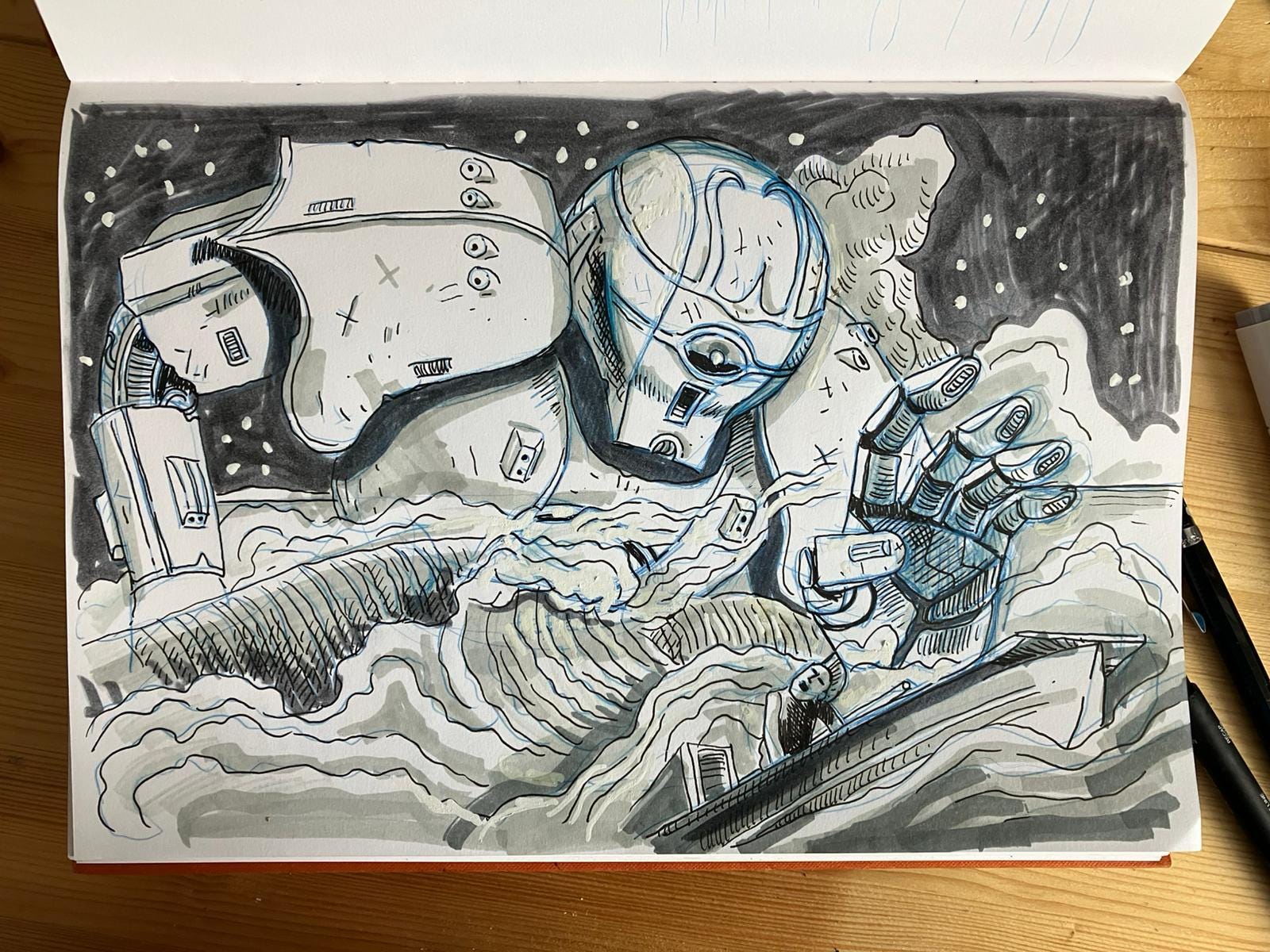
Photo of Daniel Locke’s Sketchbook
You say that Islands of Weirdhope began with the image of “a sailboat gliding through the tips of submerged skyscrapers.” I love that! How did that visual seed evolve into the full world?
Yeah my settings often start from a small visual seed. The World After was imagining that moment of emerging from an underground bunker that you’ve lived in all your life, and discovering a rewilded Earth on the surface.
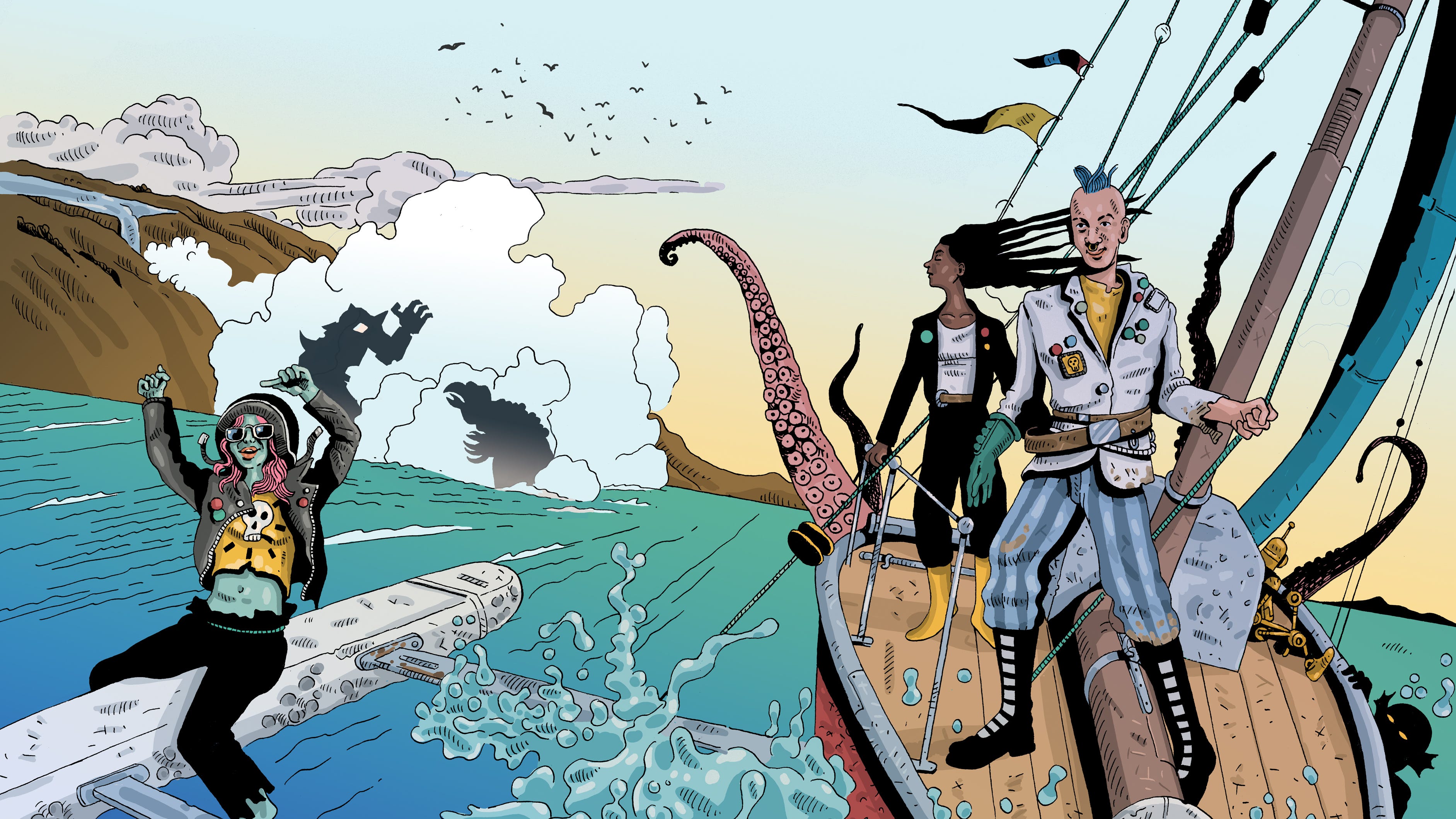
Islands of Weirdhope was essentially thinking of Windwaker, one of my favourite Zelda games, but the underwater world is not a fantasy world, but our present world, as it’s revealed in the film Waterworld. But then that idea of layers of existence, above and below water, made me think there was space to bring in a different scale of creature, like Kaiju and Mecha…
And I wanted Islands of Weirdhope to be very much about sailing, about negotiating the waves, the currents and the wind, so the Kaiju, which I called Monsters in the game, so engines, mechanical devices and explosions attract the Monsters, and they’ll eat your craft whole if they find you.
But that opens up whole new adventures of trying to escape from the dungeon of the Monster’s belly, which holds precious magical ambergris.
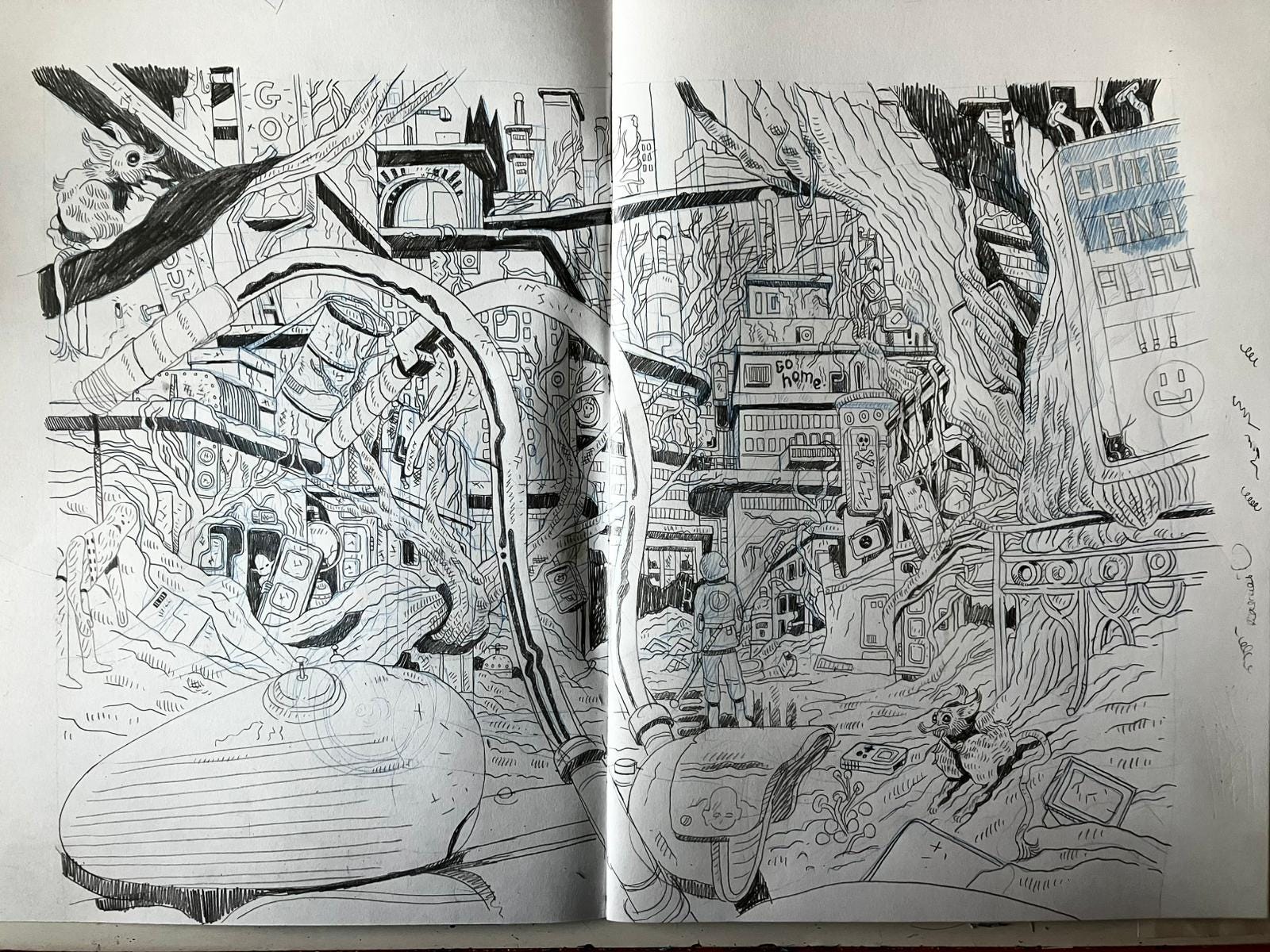
Photo of Daniel Locke’s Sketchbook
Sometimes I start with a really clear image and feel for what I want to create, but like a dream, it can often be harder and harder to hold onto that initial form the more I attempt to clarify or add to it. How do you ensure that your aesthetic remains consistent through art, setting, and mechanics?
Once I have that first image in my head, I start with lists of words, many of which become tables. Tables are a great way to organically inject lore into the game world.
Then I have long rambling conversations with Dan and we sketch together and try out ideas, but I’m blessed that Dan is on such a similar frequency to me, and gets the feeling I’m trying to create. We’ve been friends for over twenty years (we met at art school), so that chemistry makes things a really natural discovery of the world together.
I’m a creator (I make video art and music too) who likes to discover things through the actual process of making. So I start with a kernel of an idea, a feeling, but know that that will ebb and flow towards the final thing and it’s the same with the mechanics. I knew sailing would be central, and started looking at the patterns of currents, and prevailing winds, and Micronesian Stick charts (incredible physical maps of the seas), and wanted to create that feeling of freedom and danger.
So you roll more dice if the wind and current are with you or if you’re a skilled sailor, less if they’re against or your sail is broken. And then, for every leg of the journey, your ship takes a small amount of damage in a battle with the elements, greater damage in larger waves.
It makes every journey fraught with danger, eventful, and a puzzle to be negotiated.
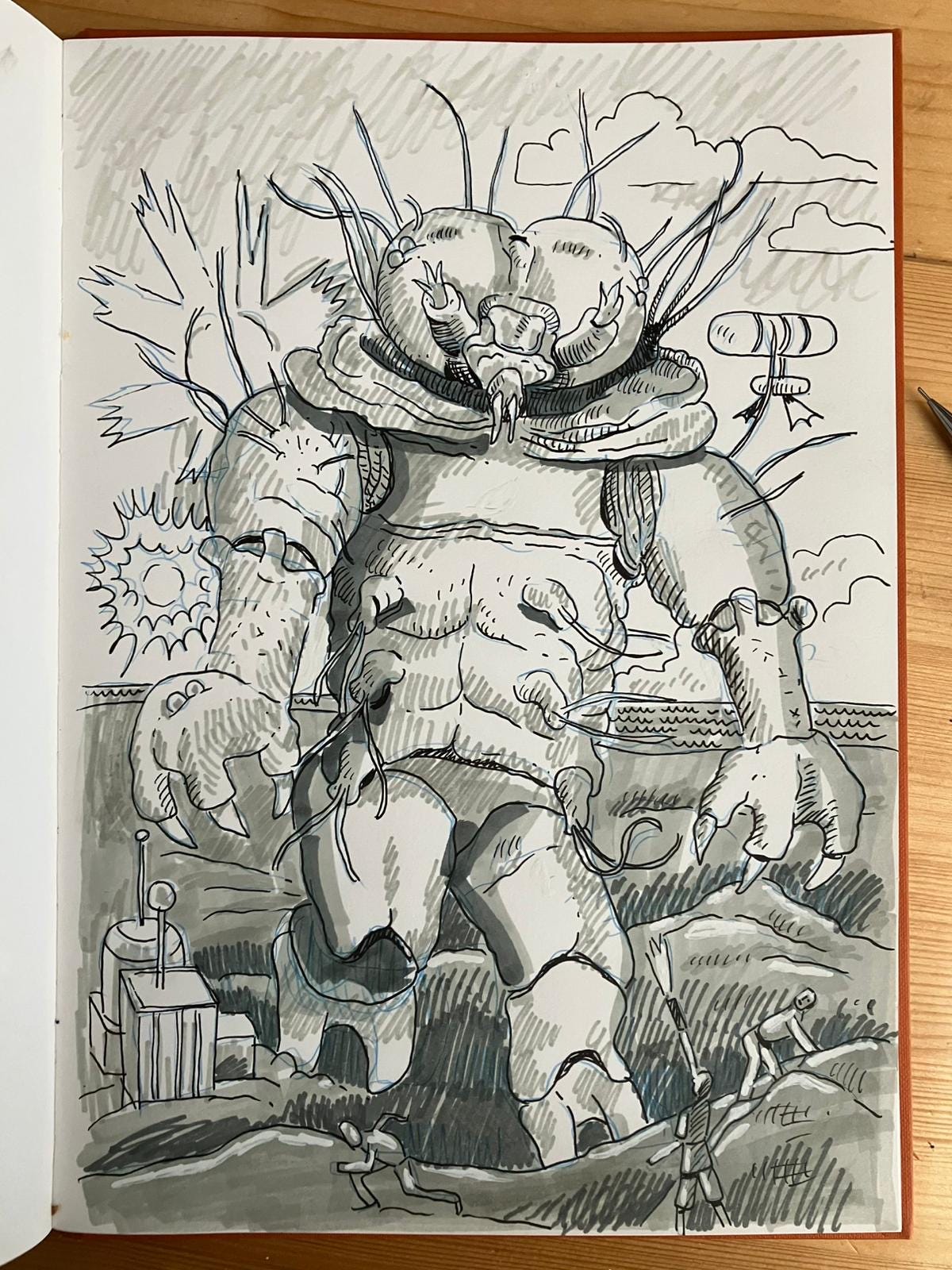
Photo of Daniel Locke’s Sketchbook
The rules-lite/procedural structure of ECO MOFOS and Islands of Weirdhope draws on games like Into the Odd and Cairn as sort of “spiritual predecessors” if you will. What mechanics or design decisions did you intentionally depart from or expand on, and why?
What my games really expand on is the idea of a procedurally generated world. I wanted the system to work for solo players but also for GMs who forgot to prep haha.
So they’re full of tables that will create interesting combinations that are unique every time, and show you more about the world. But I think they work really well for prep too, offering possibilities, either as sparks or a pick list to choose from to form your next session.
I also wanted to introduce a little storygamey emotion into the mix. Chris McDowall created the idea of Burdens in an early playtest version of Mythic Bastionland, emotional baggage that you gain from difficulty, like Cairn’s Fatigue but more specific. And I spoke with Chris and ran with it for ECO MOFOS!!, introducing twin resolutions for each Burden, either fighting against it or giving in to it.
The other thing I introduced, as a nod to British systems like Fighting Fantasy and Troika!!, was Luck, but it’s a luck you can burn like in Call of Cthulhu. The whole game is roll under, and it’s a fun stat, that goes up if you fail a roll and are unlucky, and down if you succeed, so it reaches a natural equilibrium. But if you burn luck to succeed on, say, a strength roll, you then have very low luck and most likely on your next weather roll (a luck save) you’ll get worse weather and travel will be more difficult.
It’s a simple system that interlocks in such a fun way.
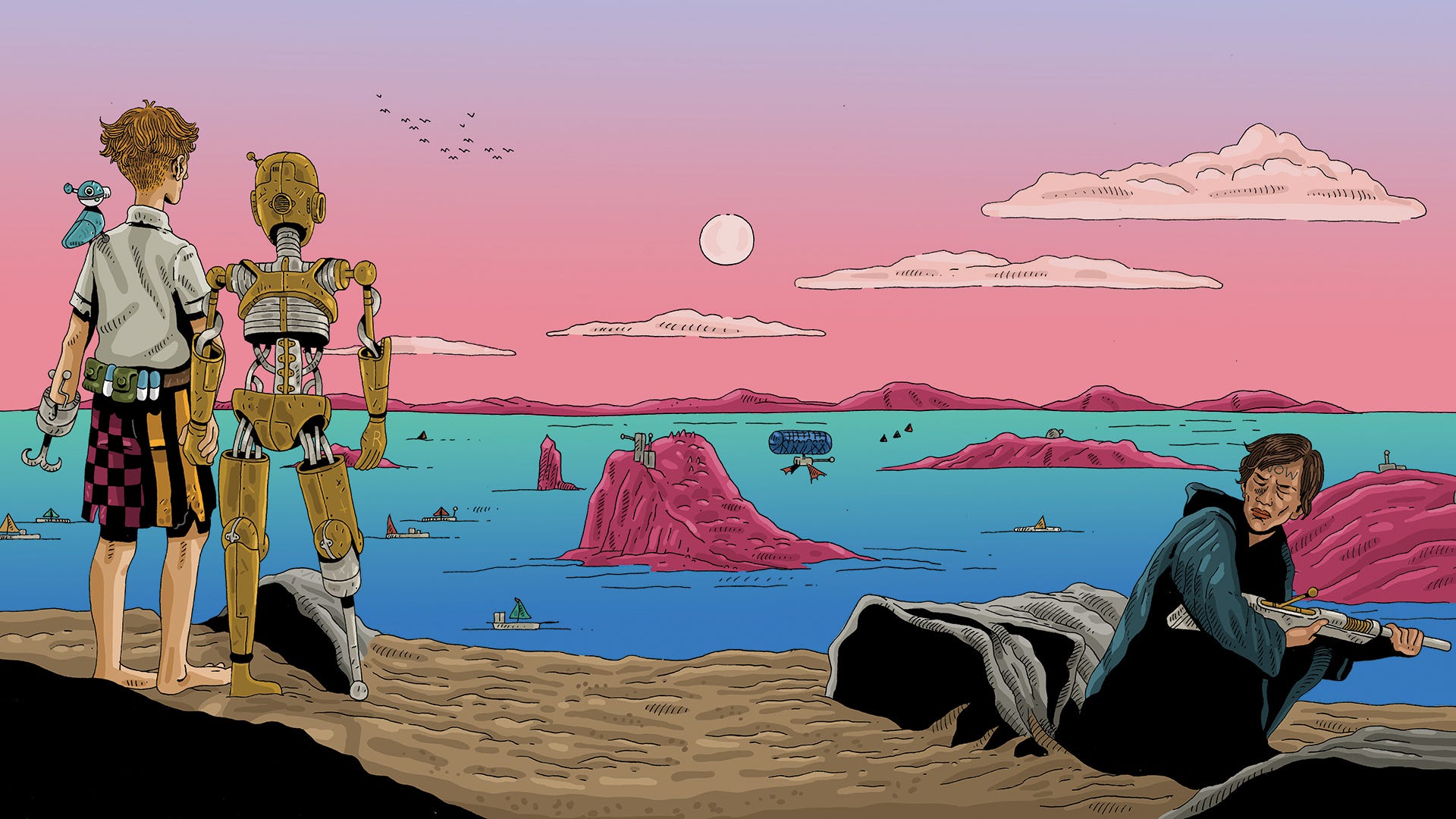
Image from Islands of Weirdhope by Daniel Locke
The theme of hope rather than grimdark is relatively uncommon in post-apocalyptic TTRPGs. I really appreciate that aspect, and its how I’ve actually run a lot of my home games of Mork Borg or Cyberpunk.
How are you trying to balance the “hazardous but hopeful” tone so players feel stakes but also agency and optimism?
Well, first of all Players know from the beginning that they’re searching for a Glade, a special peaceful place to start a new community. But then it’s infused into the world, through entries in the tables and objects that people can find. Everything is chosen to be evocative and spark the player’s imagination. There is horror, but there are also moments of wonder; the sun glinting off the sea, a school of dolphins, a beautiful sunset. There’s even a table of rays of hope that the GM can roll on intermittently to add to a scene.
Visually and thematically you draw from super diverse inspirations (studio-Ghibli, Moebius, waterworld-mecha stuff, etc). How do you coordinate the illustrations with the writing to ensure that the mechanics, art and text feel like one unified world?
I think this comes from the way that Dan and I work together- I’ll write up an idea, then he’ll be inspired to draw something from that, and then I’ll be inspired to push the writing in a certain direction.
It grows together, rather than me setting something in stone and asking an artist to fill in particular spots in the text. It helps that I do layout too, so there comes a point where I can say- could you draw something very vertical so that I can fill in this area- the spread is about a huge Cephalopod titan that squirts a cloud of ink.
Then he’ll interpret that, and I might change the text to match a detail in that image. This makes the whole thing hang together as a coherent, solid world.
Procedural generation and no-prep (or at least low-prep) play are major features of your games - they are for my own stuff, too.
I know that sometimes it can be hard to make sure that “random” doesn’t mean “incoherent.”
What was your biggest challenge/learning experience in ensuring that randomness still leads to compelling narrative moments or stuff that reinforces the feeling you’re going for rather than meaningless chaos?
I think the single most important thing in my systems are the random maps- these are 12 different pointcrawl maps, each with 7 locations (in the new version), that outline a coherent journey- points are pre-marked with random hazards and loot, and are joined by standard and secret or difficult routes.
I went through, adding in “jaquaysed” elements- loops, secret ways, multiple routes- to try to make every map have a choice to make, a physical puzzle to solve- do we risk the strange sounds to explore an unknown area?
So much of ttrpgs is making choices and concocting elaborate plans.
Often, the hardest thing for me is to kill my darlings, so to speak, and remove or leave out stuff that I personally loved but didn’t feel made sense clearly enough for the intended audience.
Can you pick one concept from the game that didn’t make it into the final version (or changed a lot in play-testing) and tell us why you cut or changed it?
That would have to be the sailing procedure. It’s gone through so many iterations, several of which you can see on my blog. There were plenty more that never saw the light of day haha! Mechanics are always a balancing act, wanting that sensation of simulation, yet being light enough to feel fun and intuitive in play. That’s my goal, anyway.
What about the community around your game? I’ve been lucky enough to have a ton of enthusiastic, creative people that felt a strong connection to my Kal-Arath zines...has player feedback taught you a lot about the world or system that you didn’t expect at the outset?
Oh wow, the Copy/Paste discord server is probably my favourite place on the internet. They’ve become a genuine group of friends, and each of them has brought new interpretations of the Eco mofos world that has just added depth and substance to the world I first dreamt up.
Obviously there’s a large kernel of our world in the setting, as you discover artifacts from our present in this future space, but the inclusion of magic coming from the Earth itself allows really psychedelic visions to exist alongside corporate horror and cosy moments of glee.
Everyone on the server has kept the world very alive for me. Our anarchic play-by-post has been a real highlight of the year. I run it procedurally, straight from the tables in the book, and it’s lovely to rediscover that space again.
Community is there in the game- you’re aiming to find a space to establish a new haven in a hostile world. But everyone in the server has made me consider how to embed that ethos into the setting even more.
With folks who are making rad things, I’m always curious (as someone who puts out a lot of physical items and appreciates that side of things more than the digital) how you handle the obstacles in that aspect of design.
There’s a pressure that comes with putting something out into the world, let alone something that has been crowdfunded. The pressure to do the work justice and make it as good as it can be. I was quite proud of the early version of ECO MOFOS!!, and the bones were all there, but the book was transformed through the process of getting it ready to print, of thinking through how to make the book as usable as possible and as clear as possible for new players, particularly players new to the playstyle.
But so much of games is how the books and zines feel in your hands, the feeling they give you just flicking through them, the way text and image go together. That’s what I really enjoy, trying to turn this feeling, even vibe, into a physical thing that can be passed around. The job of a game book is to entice you to read it, to inspire you to play. They’re gateways.
What production or fulfillment challenge would you say has taught you the most — whether in art/print, logistics, or community management/customer service?
I think the main thing I’ve learnt from my years doing this is that collaboration is key. Copy/Paste Co-op wouldn’t exist without Dan and our mutual trust. But, in general, putting TTRPG stuff out into the world can be a big logistical undertaking, with all sorts of potential pitfalls.
But they’re all problems that have existed for a long time, and some people work with them everyday. So be open to working with people with expertise. In general, working with people that you get on with and on things you love, and everything is better.
For a GM or solo-player coming to Islands of Weirdhope who knows nothing about ECO MOFOS or anything else about rules or setting, what three pieces of advice would you give to maximize the experience rather than defaulting to familiar post-apocalyptic themes or cliches?
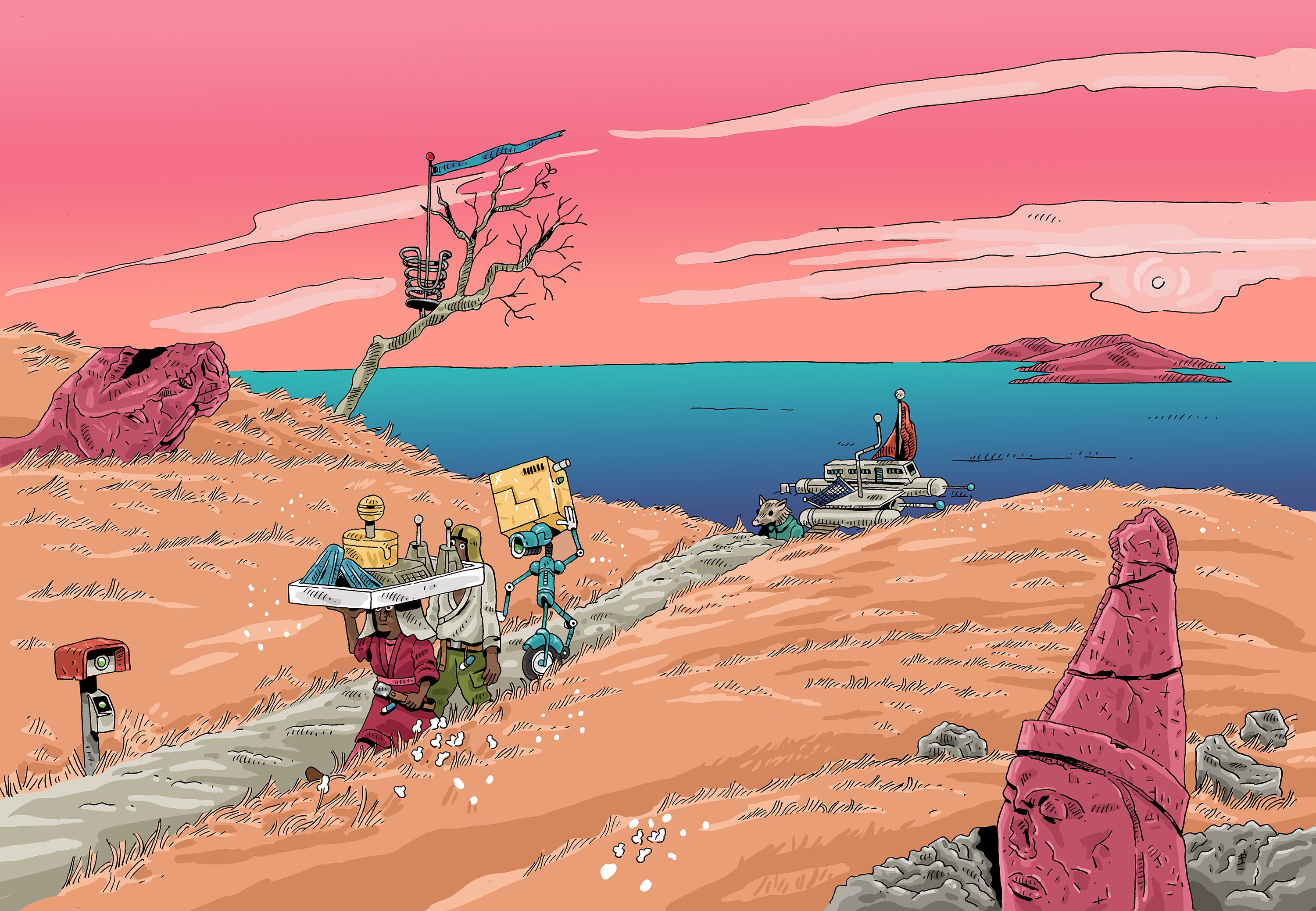
One, lean into the hope. Find moments of beauty and wonder in the setting.
Two, lean into the weird. The magic, orbs, hermits and creatures bring a lot of uncanny mystery. There’s a science fantasy mysticism to the setting, with the opportunity for magical realism.
Three, lean into the burdens. They’re a really fun way to add personality and hi-jinks to your character and their actions.
One of the reasons I included them was to encourage players not to always do the smartest or optimal thing in every situation, as you have this burden staring at you on the character sheet saying… if I just run into danger I can rid myself of this and free up space for another item. It helps make sessions dynamic and gets everyone into the fiction and their character.
Once this book is out there, how do you envision the world of Weirdhope evolving? Are there expansions, cross-overs, other media you’re exploring, or mechanics you still want to experiment with?
I have a dream of making Islands of Weirdhope into an animation. But much more likely is a comic book- Dan is a graphic novelist, and we’ve made a graphic novel together already (a pretty out-there history of the world called Out of Nothing).
Which would be a lot of fun, but such a big undertaking.
The next logical move for the game itself is into space- the Corpo base and all the billionaire scumbags are up on Mars, so it could be a great “into the Deathstar” expansion.
It’d be a lot of fun running with satire about the lifestyles of Corpos and the mega-rich, and replicant rebellion, and crazy Barsoom and Vaults of Yoh-Vombis stuff.
Final thoughts?
Thanks so much for taking the time to talk through the work. I’m a big fan of what you do, so it’s been awesome to say hello.
Thanks so much!
- CG
PS: Keep your blades sharp and hold onto your thrusters, because Arathi Sector launches (finally) this week/end!!!
Pulp, brutal sci-fi in the same universe and ruleset as Kal-Arath!
The collab I didnt expect! Grief and Hope together! Good interview!
Great interview! Considering how different the settings of Kal-Arath (brutal pulp) and Eco Mofos (ecopunk weirdhope) are, I actually think there are so many synergies between them. Maybe I'll do a crossover solo campaign one day - Eco-Arath or Kal-Mofos maybe? 🤔