
Imaginary Coastlines
On texture, nostalgia, and the creation of games with feeling

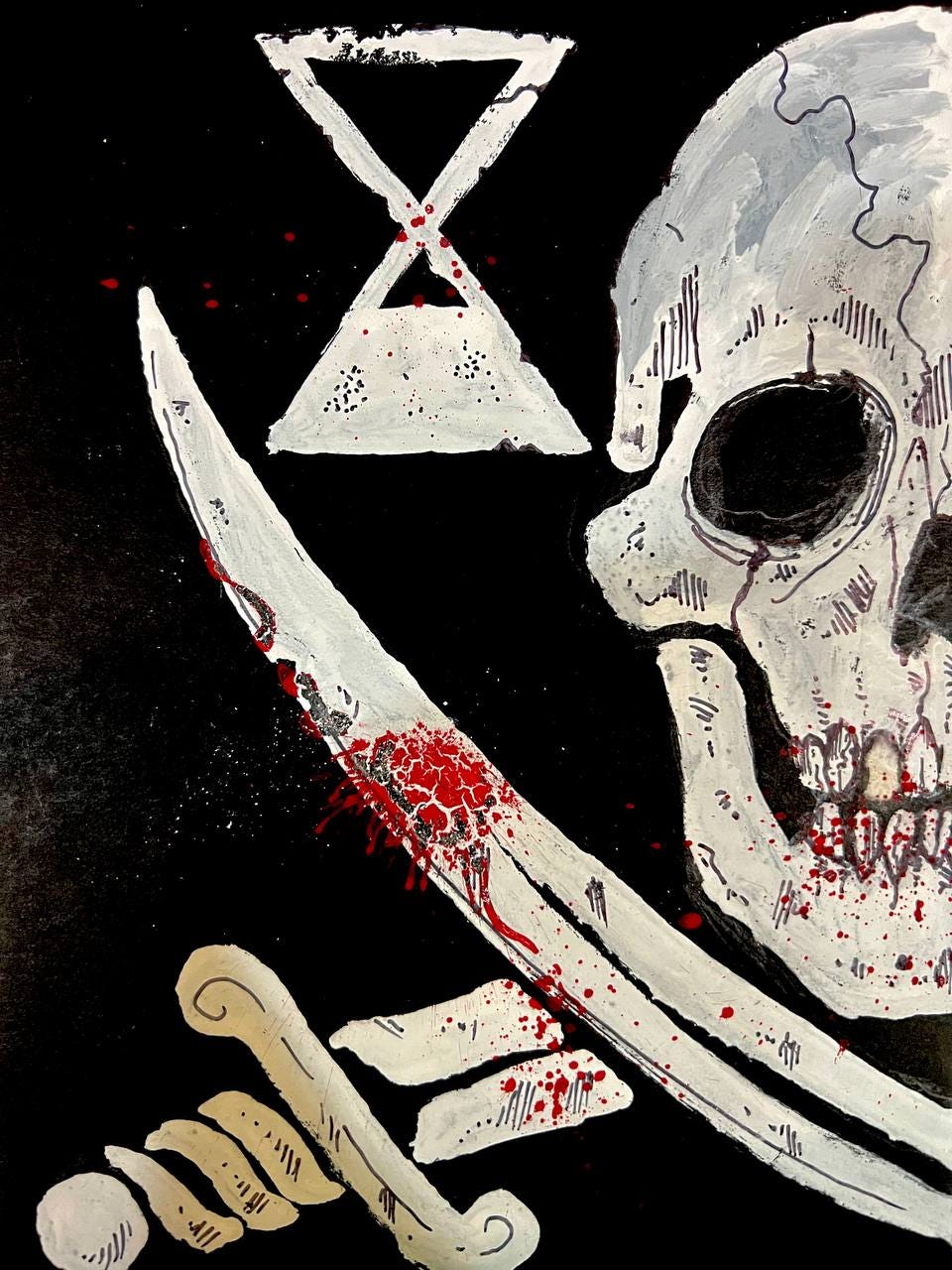
This week I experienced something that for me these days is akin to the fabled “blue moon.” Two days off work in a row, and that kind of shaky, feverish inspiration that only hits once in a great while and must be answered with complete subservience to the directive of the creative muse.
I did so.
Like Dewey Cox in Walk Hard, I can’t just tell you about it. I’ve got to go back to all the way back to childhood to make it all make sense.
My real reason for making games, drawing pictures of skeletons and maps of places that don’t exist really started, as I imagine is true for many of us, all the way back then.
I was an introverted kid, and a bit lonely, but I had a couple friends, and one of them got the AD&D 2nd Edition books for Christmas one year from a relative or something. He couldn’t make heads or tails of just what the hell kind of thing they were. A game of some kind, seemingly, but with no pieces, no cartridge, no board?
We were mystified.
But I knew right when I saw them that I was in love, and that I had discovered something incredible, something that I didn’t even grasp yet. The Easley art. The painting of the guy standing on a mountain with an axe in one hand and a bag in the other, looking to the next ridge where some kind of crystal palace or ruin rose ethereally into the sky.
The schools of magic, laid out in calligraphy on a strange sigil, looking like it had been taken out of a medieval grimoire, and the Monster Manual. My god. The DiTerlizzi watercolors especially evoked something in me that the Hobbit and the Lord of the Rings had already awakened in my young mind but this - this was something different. A place to build. A place to explore. A place to GO…
Anyways.
We spent the summer playing wrong every day after school, and I spent all my time in between elected as the de facto “figurer out of the rules,” and drawer of maps, dungeons, and the rest. I was no artist back then, but I scrawled miles of dungeon in a little black sketchbook, not a damn bit of which made a lick of sense by today’s standards. Portals to nowhere. Altars next to lava pits. Random orcs and other bad guys just hanging out underground waiting for adventurers to come along and battle them.
No one was there to tell me what was right or wrong, or how to do it. I didn’t know anyone else who played, and the internet hadn’t come along yet, so I was just feeling my way through it all. And we had a blast.
Some where along the way, we watched Cutthroat Island (a pretty bad but not altogether unenjoyable 90’s pirate film), and The Bounty with Anthony Hopkins, and it sparked an insane lust for everything nautical and piratical. Books were rented from the library. Coffee-stained maps were made to treasures and islands, and islands with treasure on them. Shipping routes charted. Basic rules cobbled together and a several year long pirate campaign launched using a mishmash of D&D and whatever seemed to make sense…none of this mattered, because what we cared about more than anything was not the rules, or getting them right, or exact historical ship data.
It was a feeling.
It was a texture.
The maps, and how they felt, and how we felt like ship captains in a creaking wooden man-o-war as we penned them with our dads old fountain pens they’d let us have.
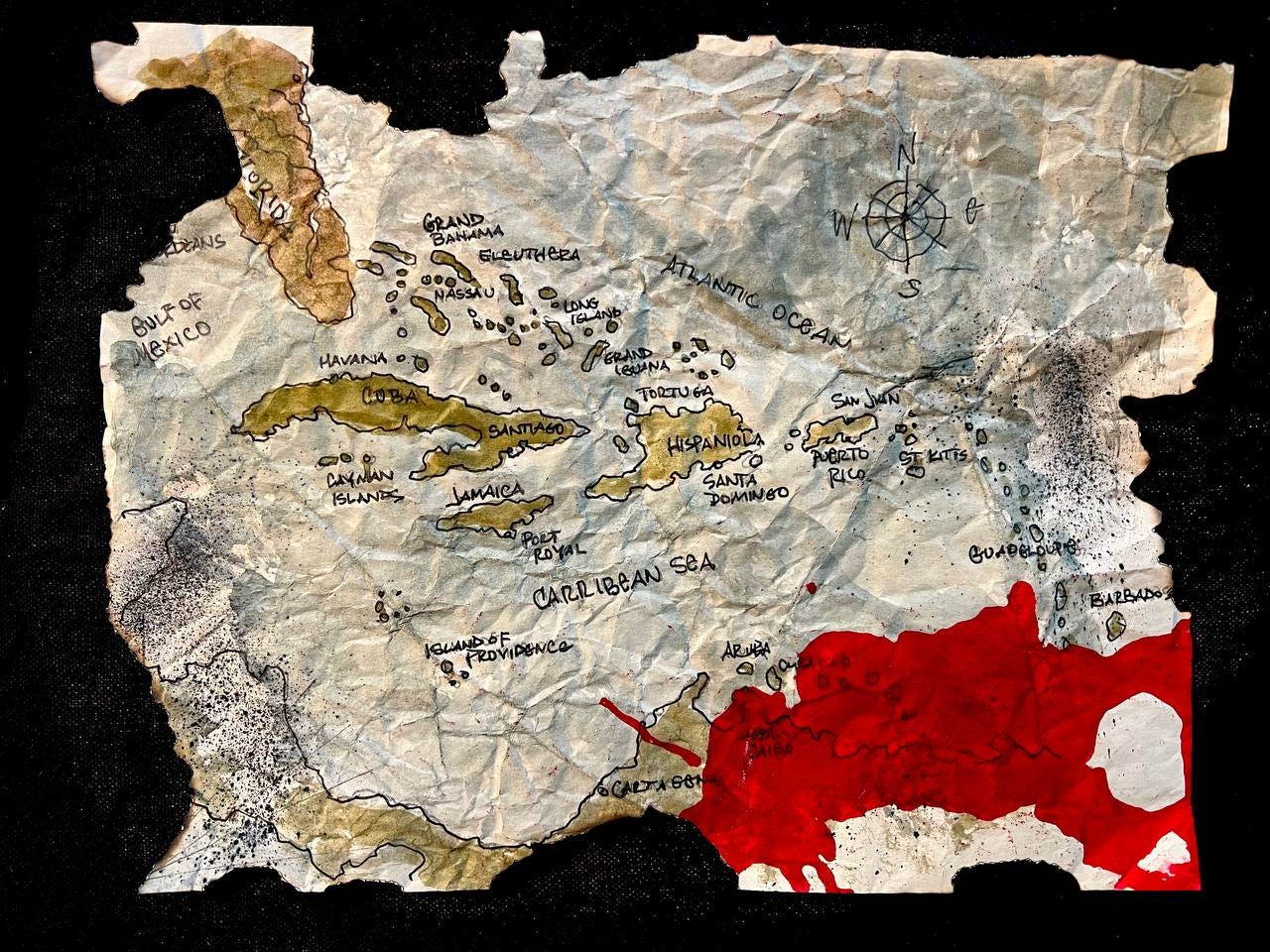
Poring over old books about Captain Kidd and Henry Morgan, and learning about the Pirate Republics of Nassau, and St. Mary, and Petit Goave.
Burning the edges of our character sheets, and badly tracing images of pirates from old NC Wyeth paintings.
This was what brought us to the table in the first place, when we didn’t even know there were other rulesets. We wanted to capture a feeling.
As I’ve gotten older, I’ve realized that rulesets are there for a good reason, and there are “good” and “bad” rulesets (at least subjectively, for me), and that the “good” rulesets are largely the ones that determine what the feeling and texture of the game session is supposed to be like.
So, when I sat down in the feverish grip of the muse this past week, it was because I had rediscovered some of this feeling after watching a few documentaries, and re-reading “Under the Black Flag” and a few of my other age of sail books that I thought I’d never read again because pirates sort of got the zombie and viking treatment over the years and were, for me, entirely played out of inspiration or interest.
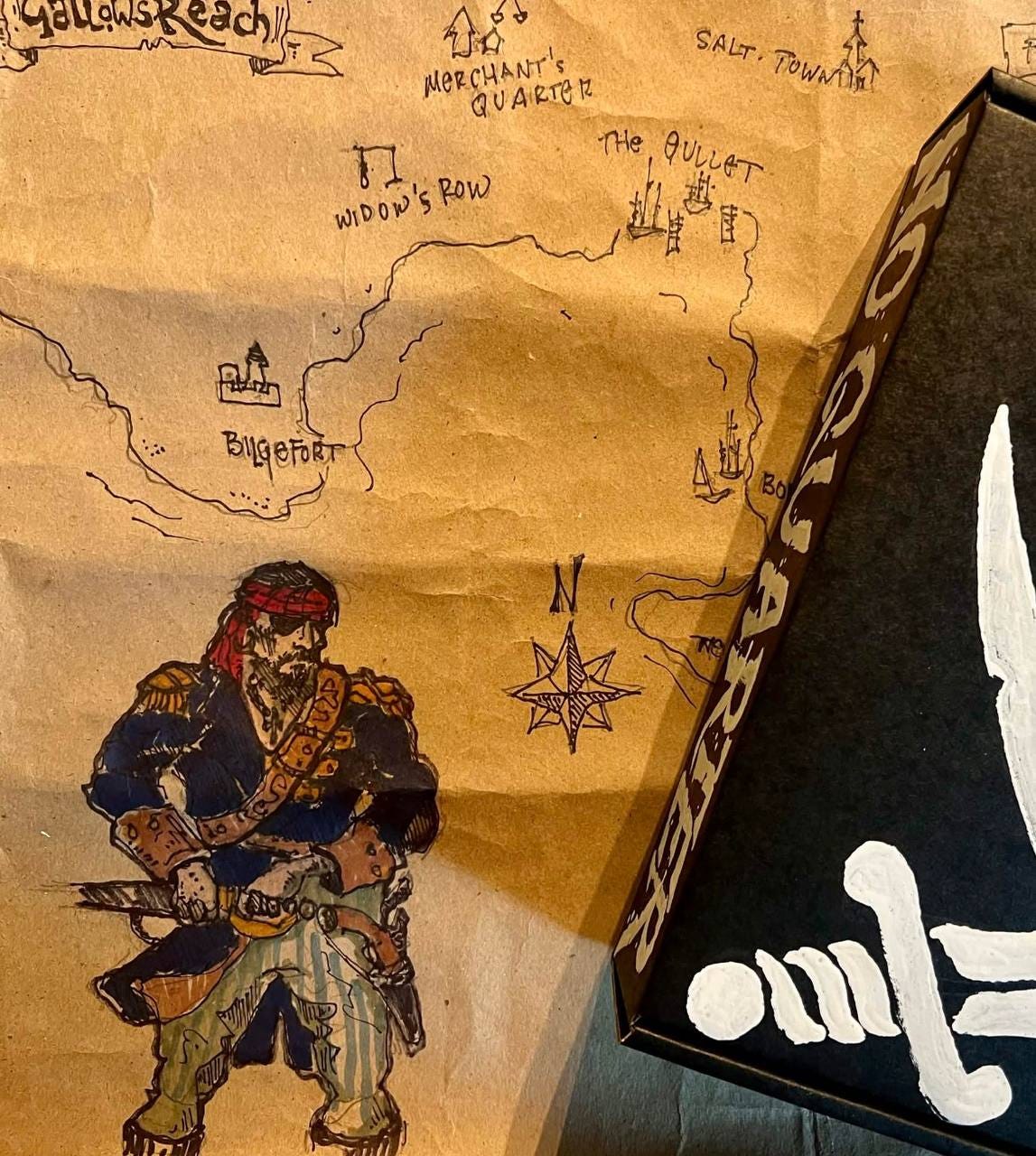
I wanted to make and play a streamlined and satisfying pirate game that was campaign-focused, gritty-realism focused (no supernatural elements), and deadly, yet fun to fight in.
The muse was possessing me.
Whatever it was, it hit my brain like a lightning bolt. I went over a few rulesets I had in my office and then it hit me again, as I saw a familiar faded white and red cover paper and cardstock booklet covered medieval heraldry.
I’d wanted a game that wasn’t King Arthur to play with the Pendragon 1e rules for a long time now. And this was it.
I read over it, again and again, taking scribbled notes and drawing little treasure maps as doodles as I considered where this all might go. What did I love about Pendragon 1e? It was a small, slim ruleset with many “holes” and “unfinished” aspects but that opened up a world of potential, much like the Moldvay Basic rules I love so much.
The art was minimal. Simple. There was much room for expanding on a good thing. And the roll under d20 system with the skill and personality trait advancement felt perfect for a grim and gritty game set in the Golden Age of piracy.
I began the work, not because I thought, “there are no other pirate games out there that are good.” Pirate Borg is very popular, but it’s just not for me. Why? The texture, the feeling, for me, is wrong. Pirate Borg is Pirates of the Caribbean. A goofy, spooky carnival ride with drunk pirate ghosts and zombies and the Kraken and all that.
I wanted a game that felt less Captain Jack Sparrow and more Black Sails, or more Captain Blood. Something rollicking, certainly, but more gritty and grounded, more character driven and shamelessly devoted to the idea of an emerging narrative that is dynastic like Pendragon, only instead of a family, it’s about a crew.
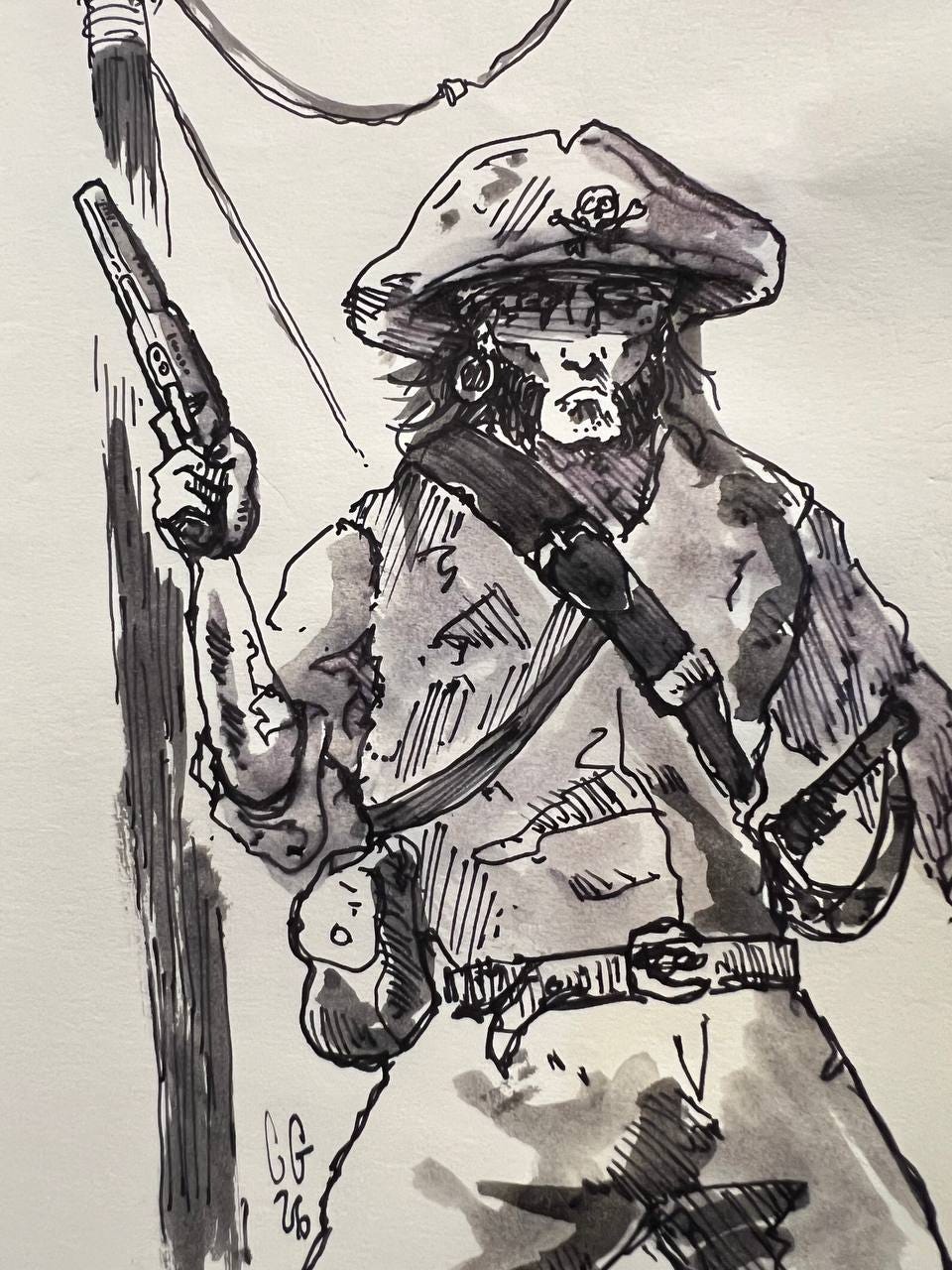
Over two straight days of putting 100% of any scrap of spare time I had outside of normal duties and family stuff, I had a draft. 20 pages with lots of typos and holes, but it turned out to be enough to run the game, newly dubbed “No Quarter,” for a group of my pals last Thursday night.
The crew survived shipwreck using their wits and skill. They avoided their rival and robbed a storehouse blind after getting to a small port with nothing but a raft, a treasure map, a couple flintlocks and some still-wet powder. They talked their way into a job and a rickety sloop, and raced against time to beat another captain to Nassau, where they outwitted and outfought him to make a name for themselves as new pirates not to be trifled with.
In the “Port Phase,” my answer to Pendragon’s “Winter Phase,” one of the players character’s contracted scurvy. Another lost a hand due to a festering wound. A third had the choice to lose face or fight a duel, where a critical success by the duelist in question and a fumble by the player led to the only PC death in the post-game wrap up section!
All these led to more notes, rivals, rumors, lies, potential betrayals, and a dramatic “mini-series” feel shaping up. Crinkled maps were handed out, and a bit of rum was had…character sheets were drawn by hand on yellowing paper.
The feeling was there. The texture was there. We had a blast.
I look forward to sharing the game report with you soon, and soon after that, the No Quarter: Basic Ruleset.
Until then - keep your blades sharp, and go for that feeling that got you into all this in the first place.
- Castle Grief
I relate so much with everything you've written. Man, I forgot about the burned edges of our coffee-stained "maps"!
Not sure there is a translation out there, but there is a French pirate RPG that's pretty solid, especially its supernatural element: "Capitaine Vaudou". https://shop.black-book-editions.fr/produit/8385PDF/0/capitaine-vaudou/capitaine-vaudou-livre-de-base
As the name suggests, the supernatural element is present but not in a goofy way, quite the contrary: voodoo and zombies are for sure, but truly scary. And the price to pay to bargain with Loa spirits of vodun is always steep, as they hunger for your soul or your blood: you can strike a bargain, just don't think you can try and trick them.